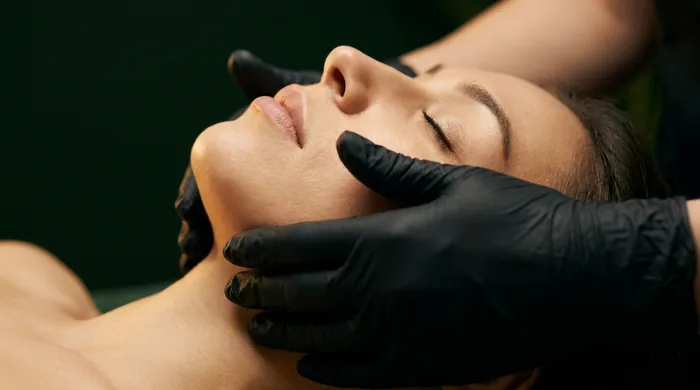
A traditional facial polishes the surface. A myofascial release facial addresses the structure beneath it. One leaves you brighter for a week. The other changes the architecture of your face over a series of sessions. Both have a place. The difference matters more than the marketing usually admits.
If you've been getting traditional facials for years and have started wondering why the results don't last, or why your face looks tired in a way no serum seems to reach, this article is for you. We'll cover what each modality does, what each can't do, and how to choose between them depending on what you're trying to change.
The fundamental difference: surface versus system
Traditional facials work on the skin and its immediate underlying tissue: cleansing, exfoliating, extracting, applying actives, massaging the superficial muscles. The goal is to change what's visible on the surface — texture, tone, hydration, brightness.
Myofascial release facials work on the connective tissue layer beneath the skin: the fascia. Fascia is a continuous web of collagen and elastin that runs throughout the body, wrapping every muscle, organ, and structure. In the face, this web defines contour, holds the architecture of your features, and determines how the overlying skin sits and moves.
When fascia is healthy and hydrated, it glides smoothly across the structures beneath it. When fascia is restricted — from held muscular tension, postural patterns, dehydration, or simply time — it creates areas of restriction and downward pull. The skin above gets compressed, dragged, or pulled into asymmetry. No topical product reaches this layer. A traditional facial doesn't touch it.
This is the core distinction: traditional facials address what is on the skin. Myofascial release facials address what is pulling on the skin.
What a traditional facial actually does
A traditional facial typically follows a sequence: cleanse, steam, exfoliate (mechanical or chemical), extractions, mask, serum, moisturizer. The goal is surface optimization — clearing congestion, sloughing dead skin, restoring hydration, and depositing active ingredients into the upper layers of the epidermis.
Done well, a traditional facial:
- Improves skin texture and clarity for several days to a few weeks
- Clears congestion from clogged pores
- Boosts skin hydration through occlusive and humectant ingredients
- Provides a noticeable temporary glow
- Maintains skin health between regenerative interventions
What a traditional facial does not do:
- Address the underlying structural causes of jowling, midface descent, or facial heaviness
- Soften held muscular tension in the masseter, pterygoids, or buccinator
- Restore fascial mobility and soften areas of fascial restriction
- Change facial symmetry or contour in any lasting way
- Affect lymphatic drainage at a system level
None of this is a criticism. A traditional facial is doing exactly what it's designed to do. The mistake is asking it to do structural work it was never built for.
What a myofascial release facial does
A myofascial release facial works at a different depth and with a different goal. The technique is manual — practitioner's hands working directly with the fascial layer through sustained pressure, slow gliding strokes, and targeted release at points of adhesion.
At Altru Radiance, the Restorative Buccal Facial is our signature myofascial-driven service. It runs approximately 90 minutes and integrates buccal work, external lymphatic drainage, cervical and jaw release, and structural facial sculpting. The technique addresses fascial restriction directly, across multiple layers and entry points.
What a myofascial release facial does:
- Softens held tension in the facial muscles (masseter, pterygoids, buccinator)
- Restores fascial mobility, allowing tissue to glide rather than drag
- Improves facial symmetry by addressing one-sided tension patterns
- Activates lymphatic drainage for sustained decongestion
- Lifts the midface through structural release rather than topical tightening
- Softens jaw-holding patterns and the visible tension they create
- Produces cumulative structural change over a series of sessions
The visible effect after a single session: cheekbones more defined, jawline more articulate, midface lifted, skin tone more even. The structural effect after a series: tissue that no longer holds the old patterns of tension, asymmetry, and downward pull.
When each one is the right choice
Both modalities have their use cases. The right answer depends on what you're trying to accomplish.
Choose a traditional facial when:
- Your concerns are primarily about skin surface — texture, congestion, dullness, mild breakouts
- You want a polished look for a specific event in the next week
- You're maintaining skin health between more regenerative interventions
- You enjoy the ritual of a traditional facial and the visible immediate glow
- You're working on a specific skincare protocol and need professional extraction or exfoliation support
Choose a myofascial release facial when:
- You're noticing structural changes you don't like — descent, asymmetry, heaviness
- You hold significant tension in your jaw, neck, or face (clenching, masseter heaviness, set expression)
- Topical skincare has plateaued — you're using good products and the results have stopped compounding
- You want lasting change rather than a temporary surface effect
- You're seeking a non-injectable approach to structural facial concerns
- You want to address the cause of facial heaviness rather than mask it
If you've been treating your face as a surface and the surface keeps falling short, it's time to address what's underneath. Book a Restorative Buccal Facial and feel the difference structural work makes.
Reserve Your SessionWhat it feels like in session
A traditional facial is sensory: warm steam, the texture of a clay mask, the smell of essential oils, the cool finish of a serum. The work is light, often relaxing, and largely surface-level. You stay in the same passive position for most of the session.
A myofascial release facial is different. It's still a deeply relaxing experience — most clients drift into a deeply calm, almost meditative state, often light sleep — but the work itself is substantive. The pressure is deliberate. The technique moves systematically through layers. Buccal work begins after the external warm-up, with sterile gloves, gentle pressure that builds as tissue softens. You feel the work in a way you don't feel a traditional facial — not painfully, but unmistakably.
Many clients describe their first myofascial release facial as "the first time my face actually let go of something." The reason: it's the first time the ingrained tension patterns underneath have been directly addressed.
When results show up and how long they last
Traditional facial: Results visible within minutes to hours. Surface improvement lasts roughly one to two weeks before normal cellular turnover and environmental load return the skin to baseline. Best maintained with monthly sessions.
Myofascial release facial: Visible lift and tone within hours of the first session, with continued improvement over 48 to 72 hours as lymphatic drainage continues. Structural change is cumulative. A single session shifts the tissue; a series of 3 to 6 sessions creates change that holds between visits. Monthly maintenance from there sustains and continues progressive improvement.
For a closer look at what buccal release specifically does within this work, see our article on what buccal release is and the buccal muscles it addresses.
Can you combine them?
Yes, and many clients do. The combination most often works like this: monthly Restorative Buccal Facial as the structural work, with periodic traditional facial-style services for skin surface optimization. This is also why we offer microneedling + skin boosters separately — to address skin quality with the same level of attention we give to structure.
The wrong combination: treating a traditional facial as a substitute for structural work, or treating myofascial release as a replacement for skin care. They address different things. Both belong.
How many sessions to see the difference
For clients new to myofascial release facials at Altru Radiance, we recommend:
- A Welcome Bundle (two foundational sessions) to experience the work and see how your tissue responds
- A series of 3 to 6 sessions over 6 to 10 weeks for meaningful structural change, particularly for clients with significant jaw tension or visible asymmetry
- Monthly maintenance from there to sustain and progressively improve results
Like any work that addresses long-standing holding patterns, the change is cumulative. The tissue learns what its new resting state can look like over a series — not in one session.
Booking a myofascial release facial in Murray, Utah
Altru Radiance is located in Murray, Utah, near Fashion Place Mall — serving the Salt Lake Valley including Murray, Millcreek, Holladay, Sandy, Cottonwood Heights, Draper, and Salt Lake City.
The Restorative Facial + Buccal Release is the most complete entry into structural facial work. For clients adding lymphatic support, see also the five signs you need lymphatic drainage.
Ready to address what's underneath? Book a Restorative Buccal Facial at Altru Radiance in Murray, UT.
Reserve Your Session