Many people come to Altru Radiance after noticing jaw tension showing up in their face. A heavier masseter, a squarer jaw line, a more set expression that wasn't there ten years ago. They search for understanding — and what they find online is often medical content about TMJ disorder, which isn't quite what they're experiencing.
This article is for them. It's a fascia-forward, aesthetic look at how jaw tension visibly shapes the lower face — and what the Restorative Buccal Facial at Altru Radiance does for that appearance.
How jaw tension shows up in the face
The face is an architecture. The muscles you use every day shape the tissue that lies on top of them, and habits — how you hold your jaw, how you express, how you sleep — leave visible marks. People who carry jaw tension often see four characteristic changes in the lower face:
- Visible masseter heaviness — a thickening at the sides of the jaw, just in front of the ear
- A more squared lower face — the natural taper from cheekbone to chin softens
- A heavier expression — the face reads more set or guarded, especially at rest
- Earlier and deeper folds along the jaw line — nasolabial folds extending further, marionette lines emerging
These changes aren't pathology. They're the visible result of years of patterned muscle use, the same way a runner's calves shape themselves, or a guitarist's hands develop calluses. The face responds to repeated use.
Why the masseter widens the lower face
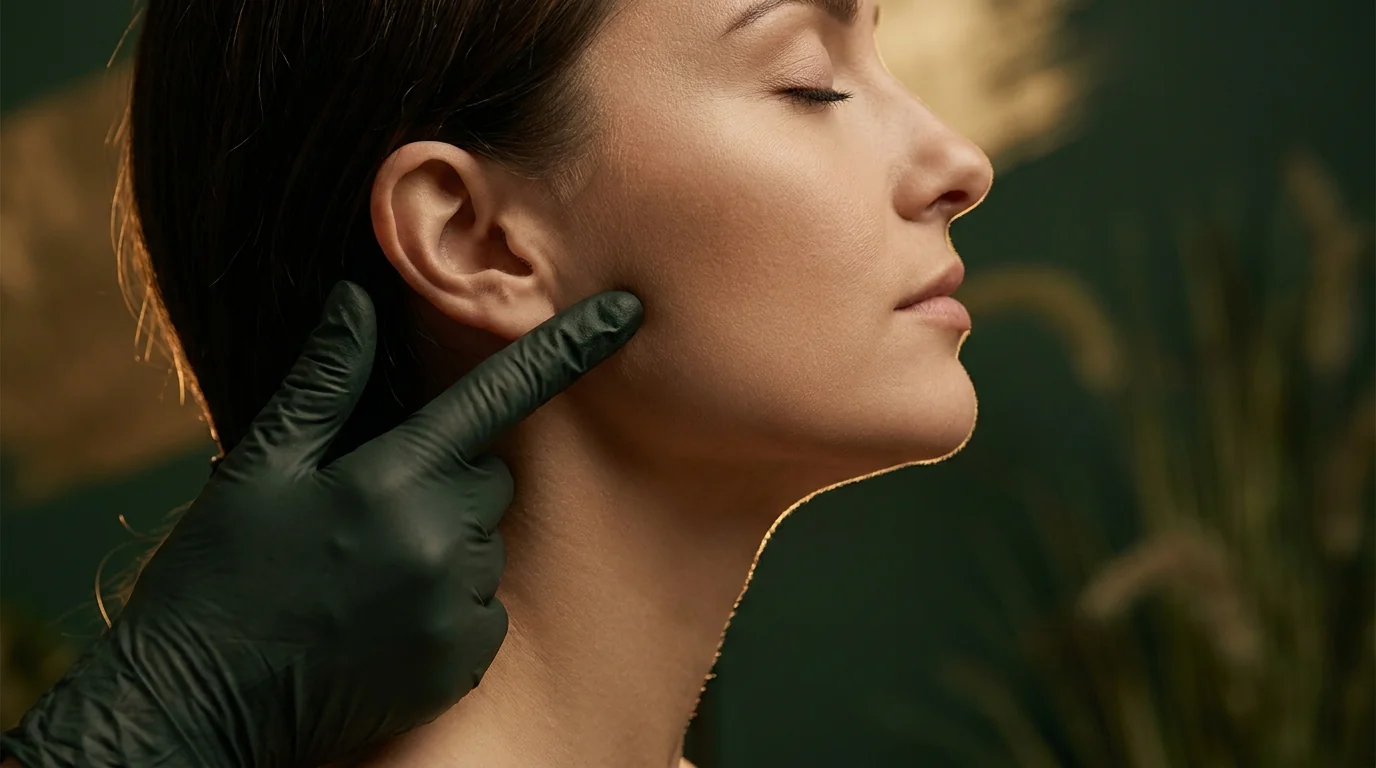
The masseter — the chewing muscle on the side of the jaw — is the body's strongest muscle relative to its size. When it is held tight — knowingly or not — it works against itself. Over time, that repeated load builds masseter heaviness. Think of it the way a bicep builds with curls — the masseter, used habitually, gets thicker. As it thickens, it visibly widens the lower face.
The widening isn't subtle once it's there. The natural V-shape of the lower face — wider at the cheekbones, tapering toward the chin — softens. The face starts to read more square, more bottom-heavy. Many people first notice this in photos before they notice it in the mirror.
The muscles of mastication and why they affect appearance
Four muscles drive jaw movement. Their location and overuse patterns shape the appearance of the lower face.
- Masseter The most superficial chewing muscle, runs from cheekbone to lower jaw. Its overuse drives the most visible widening of the lower face.
- Temporalis Fan-shaped, spans from temple to jaw. Contributes to closing the jaw. When habitually tight, contributes to the heavier, more set expression at rest.
- Medial pterygoid Sits inside the cheek, connecting jaw to skull base. Works with the masseter on jaw closure and side-to-side movement. Best reached from inside the cheek.
- Lateral pterygoid Sits even deeper, attaching to the jaw joint itself. Drives jaw opening and protrusion. Also reached from inside the cheek.
The two pterygoids are anatomically positioned where surface work cannot fully reach them. They sit inside the architecture of the jaw, and the only way to work with them directly is from inside the cheek. This is the anatomical reason buccal-area work is part of an aesthetic protocol for the lower face — not because of any medical claim, but because these muscles shape what the face looks like, and they're not reachable any other way.
How daily habits shape what shows up in your face
The face is shaped by what the muscles underneath do every day. For people who see jaw tension in their lower face, the visible pattern usually traces back to four daily habits — most of them so familiar they happen below the level of awareness.
Habitual jaw tension. The masseter responds to repeated load the way any muscle does: it builds. Years of holding the jaw tight during sleep, focus, or stress visibly thickens this muscle and widens the lower face. Most people hold more than they realize.
Head position. After years of screen time and desk work, many people settle into a habit of carrying the head slightly forward. The jaw tends to rest a little more open in that position, and the masseter stays lightly engaged rather than fully at rest. Over time that habitual engagement is often visible as a heavier-looking lower face and a more set expression.
Breathing habits. Whether the lips rest together and where the tongue sits at rest both influence how the face develops and holds its shape. In people whose habitual pattern keeps the mouth slightly open, the midface loses some of the gentle support the resting tongue otherwise provides, and the masseter tends to take on more of the work. What’s often observed over years is a flatter-looking midface and more width through the lower face.
Held expressions. Stress, focus, and habitual emotional expressions live in the face. The same expression repeated enough times across a decade creates fine-line patterns where the muscle pulls and tissue folds. This is observable in everyone, but jaw tension specifically lives in the masseter, temporalis, and around the mouth — the muscles most involved in everyday expression.
These habits aren't problems to be fixed — they're just things bodies do. But they all leave visible marks in the face, and noticing them is the first step in understanding why your face has the architecture it has.
What the Restorative Buccal Facial does for the lower face
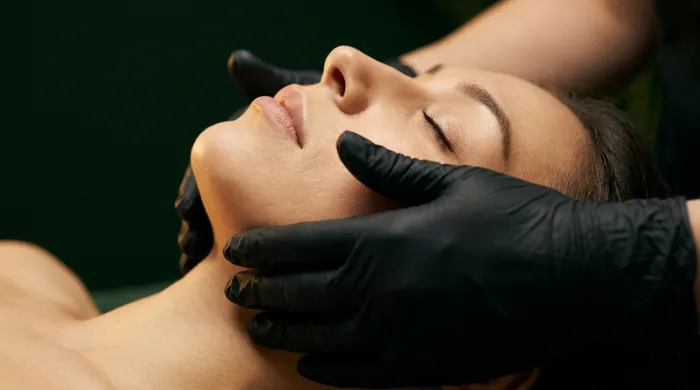
The Restorative Buccal Facial at Altru Radiance is a 90-minute cosmetic facial that combines hands-on fascia work, manual lymphatic drainage, and Korean skincare. The internal portion — buccal work performed through the inside of the cheek with sterile gloved hands — is the part that distinguishes it from other facials.
For appearance purposes, the buccal portion works with:
- The masseter and temporalis from inside, where surface work doesn't reach
- The fascia connecting these muscles to the surface tissue
- The lymphatic pathways that drain the lower face
The cosmetic outcomes most clients see across a series:
- A more defined jaw line as masseter heaviness softens
- A less heavy, more open look in the lower face
- Visible lift in the cheekbones and midface
- Less fluid pooling in the lower face
This is cosmetic work — not medical treatment. The focus is what you see in the mirror, what photographs differently, how the face holds itself at rest.
What happens during a session
If you've never had buccal work done, knowing what to expect is the most effective thing I can do to reduce any hesitation. Here's a step-by-step walkthrough of what a session looks like:
A brief conversation about your goals, what you'd like to see change in the appearance of your lower face, and any contraindications.
Mechelle gently palpates the upper face and neck to understand where tension is concentrated and where the work will focus.
Before any internal work, an extended external sequence: scalp, neck, jaw line, and décolletage. This warms the tissue, supports lymphatic flow, and prepares the face for the restorative work.
Sterile gloves; slow, intentional manipulation inside the cheek. The masseter, pterygoids, and buccinator are worked one at a time. The pressure is always responsive to your tissue and your feedback.
A targeted skincare sequence closes the session — making sure your skin leaves hydrated, glowing, and supported.
What the buccal portion feels like
The buccal portion is the most intentional part of the session — focused, attentive work that responds to your tissue rather than working against it. Most clients describe it as deeply absorbing: different from a relaxation facial, but still entirely guided by your comfort.
First sessions tend to feel the most acute, since the masseter and pterygoids are often unaccustomed to direct contact. As the tissue softens across a series, subsequent sessions become noticeably more comfortable. The work is communicative throughout — you set the pace.
What you might see across a series
A single session produces visible same-day change for most clients — a softer jaw line, less puffiness, more cheekbone definition. These are cosmetic outcomes you can see in the mirror within an hour of leaving.
Across a series of 3–6 sessions, the changes build:
- A more defined jaw line that holds between sessions
- Visibly less heaviness in the lower face
- Softer, more open midface and cheekbone area
- A face that reads more rested
Like any aesthetic practice, the results are cumulative and respond to consistency. Monthly maintenance after a series helps sustain the visible changes.
Common questions about the Restorative Buccal Facial
Will the Restorative Buccal Facial help with my TMJ?
No. This is a cosmetic facial. I don't treat medical conditions, and if you're experiencing TMJ pain, clicking, or dysfunction, please see a dentist or physical therapist. What the Restorative Buccal Facial CAN do is work with the visible appearance of the lower face — the masseter heaviness, the squared jaw line, the lower-face fullness that many people with jaw tension also experience visually.
How is the Restorative Buccal Facial different from a regular facial?
A regular facial works on the surface — cleansing, exfoliating, applying actives. The Restorative Buccal Facial works on the architectural layer beneath. Sterile gloves allow me to manipulate facial muscles and fascia from inside the cheek, accessing the buccinator, masseter, and pterygoid muscles that cannot be reached externally. The goal is visible lift and a more defined lower-face appearance.
How many sessions do I need to see results?
Most clients see visible change after a single session — a softer jaw line, more cheekbone definition, less lower-face heaviness. For meaningful visible change that holds across time, a series of 3–6 sessions over 6–10 weeks is recommended. After the series, monthly maintenance sustains the visible appearance changes.
Where can I book the Restorative Buccal Facial in Murray or Salt Lake City?
Altru Radiance in Murray, Utah (near Fashion Place Mall) offers the Restorative Buccal Facial performed by licensed Master Esthetician Mechelle To. Serving Murray, Salt Lake City, Millcreek, Holladay, Sandy, and the greater Salt Lake Valley.
Booking in Murray + Salt Lake Valley
The Restorative Buccal Facial is a 90-minute session at Altru Radiance in Murray, Utah — near Fashion Place Mall and serving the greater Salt Lake Valley including Salt Lake City, Holladay, Cottonwood Heights, Sandy, Draper, and South Jordan.
$250 single session. Foundation Package: 3 sessions for $700 (saving $560 over the single-session rate). Monthly Maintenance Membership: $230/month with a 3-month minimum.
Book online or call (801) 660-8933.